I've been meaning to write about this topic for a while. My experience with them over the past year has given me a perspective that I've really wanted to share. I was reminded this morning by some pain around one of my ribs on the left side of my chest, likely a tumor pushing on something as I'd mentioned yesterday.
When I was at my worst last year, I had to deal with pain. Right before my pleurodesis, as I was in pre-op, I felt a sharp pain in both sides of my chest. It wasn't fully correlated with my tumors; while I had a lot of them in me, mainly on the left side of my chest, I think some of it was the stress of the moment. I called for the nurse, and she gave me an IV push of dilaudid. Almost immediately, I felt a warm feeling starting from the center of my chest pushing outward and pushing all the pain out of my body. I also felt sedated and calm. It creeped me out a bit -- did I just get high?
I have to say, though, that dilaudid was very helpful in getting through those days. First, the ones in the hospital for pleurodesis, and then right before I started chemo again, thanks to pain from a spine tumor that oxycodone barely made a dent in. Yes, I've gotten quite familiar with the opioid family of medicines. With most chemo regimens, aspirin and ibuprofen aren't allowed because of their blood-thinning effects. So if Tylenol doesn't work, the only choice left is to go with a narcotic.
I'm glad my pain went away quickly after I started chemo, minimizing my need for painkillers. Once I experienced the effects of the dilaudid push, I felt that I saw in a way that I hadn't seen before the tempting nature and addictive potential of these drugs. Looking back on that experience, where I was able to get a very strong painkiller (here's an interesting chart showing the relative strengths of different opioid medicines -- dilaudid is four times as strong as heroin, which is actually a legally available prescription drug in some countries) on demand, I remembered how downright miserable I felt. My tumors were causing me pain, fatigue, lack of appetite, coughing, and on-and-off fevers, and I was only getting sicker. The narcotic high was about the only thing that could wipe that all away, at least temporarily. So even with all the negative connotations around the term "getting high," it is in fact medically necessary to do so sometimes. I was fortunate to recover from that condition so that it was no longer necessary, but for many other cancer patients with advanced disease, it is a way to ease their last moments of life.
For all the good that these medicines have done, though, they also are major contributors to the societal problem of drug addiction. Sometimes it is a result of having to take opioid medicines for a long time due to severe chronic pain. But in other cases, otherwise healthy individuals are using them for the "feel good" effects. I wanted these medicines when I was feeling utterly miserable. The question in my mind is, what is the source of sadness, unhappiness, emptiness, or frustration in the lives of otherwise healthy people that makes them feel like they need to turn to drugs that are this powerful for an escape? Based on this, I feel that the mental health aspects associated with this, or any other illness for that matter, should never be neglected.
Sunday, May 8, 2016

Saturday, May 7, 2016
No pain, no gain?
Sure feels like it. The regorafenib didn't work. I got the news on Wednesday. The pleural tumors grew; the largest is now 2.6cm. Three enlarged lymph nodes near the heart, and some tiny lung spots too. And I'd had my life (mostly) back. I was going to work full-time again and getting stuff done. Thankfully I got one project I was working on to a stage where I could submit a paper. Fingers crossed...
So now, I've had two treatments which are low on side effects compared to my others (regorafenib and Keytruda), and neither worked. The "classic" chemo treatments that did work were, on the other hand, harsh. Does that mean that a treatment has to be tough in order to work? I sure hope not! But I wouldn't mind that holding true now. I'm considering a few options, that I expect to be harder on me than regorafenib:
1. TK-216 clinical trial: this is one of the first drugs specifically targeted to Ewing's sarcoma. It's supposed to act on a protein produced by the EWS/FLI-1 gene fusion present in most cases of Ewing's. The downside is that it's a Phase I trial. In Phase I trials, the goal is to establish the right dose to give to human patients. So patients start at a low dose, likely to be subtherapeutic. Subsequent patients (they are organized into cohorts) get higher doses; this escalation continues until unacceptable side effects (formally referred to as dose-limiting toxicities) result. Some Phase I trials allow for dose escalation within cohorts, and some don't. I meet with the closest participating institution (UCLA) on Monday to find out all the details.
2. Vigil clinical trial: this is a Phase II trial of a vaccine made from a patient's individual tumor. The idea is to train the immune system to recognize tumors as foreign entities and kill them. Phase II means the dose has been established; the goal now is to study efficacy. In this trial, there's also a comparison arm with a chemotherapy regimen (gemcitabine/docetaxel) used to treat a number of sarcomas. Assignment to arms is at random, so there's only a 50% chance of getting the vaccine. The other issue is that surgery is required to obtain the tumor sample used for vaccine production (unless I get "lucky" and have at least 500 mL of pleural effusion handy), and surgery has had a history of causing any tumors in the vicinity of the operation to blow up and grow even more quickly (the one exception was my amputation, where the cut was made in a disease-free area and all of the tumors were removed). On top of that, I'm not sure how much local control of remaining tumors if any I'll be allowed to pursue while I'm recovering from surgery/the vaccine is being produced. The closest participating location for this trial is a sarcoma clinic in Santa Monica, which I'll also be visiting to get more details.
3. More chemo: there are a couple of drug combinations I can still try, which I can get these close to home. One in particular has shown promise in early published data; I'll be more specific if that's the route I end up pursuing.
On top of deciding between these options for systemic treatment, I'll also be looking at using radiation to kill the tumors I currently have. I think I can feel one of my pleural tumors starting to push on something, which has resulted in a feeling of heaviness/tightness on the left side of my chest near where I had my thorascopic surgeries last year. I can still breathe fine for the moment, but that won't last forever if I don't do something. Hopefully I'll have a decision in a few days.
So now, I've had two treatments which are low on side effects compared to my others (regorafenib and Keytruda), and neither worked. The "classic" chemo treatments that did work were, on the other hand, harsh. Does that mean that a treatment has to be tough in order to work? I sure hope not! But I wouldn't mind that holding true now. I'm considering a few options, that I expect to be harder on me than regorafenib:
1. TK-216 clinical trial: this is one of the first drugs specifically targeted to Ewing's sarcoma. It's supposed to act on a protein produced by the EWS/FLI-1 gene fusion present in most cases of Ewing's. The downside is that it's a Phase I trial. In Phase I trials, the goal is to establish the right dose to give to human patients. So patients start at a low dose, likely to be subtherapeutic. Subsequent patients (they are organized into cohorts) get higher doses; this escalation continues until unacceptable side effects (formally referred to as dose-limiting toxicities) result. Some Phase I trials allow for dose escalation within cohorts, and some don't. I meet with the closest participating institution (UCLA) on Monday to find out all the details.
2. Vigil clinical trial: this is a Phase II trial of a vaccine made from a patient's individual tumor. The idea is to train the immune system to recognize tumors as foreign entities and kill them. Phase II means the dose has been established; the goal now is to study efficacy. In this trial, there's also a comparison arm with a chemotherapy regimen (gemcitabine/docetaxel) used to treat a number of sarcomas. Assignment to arms is at random, so there's only a 50% chance of getting the vaccine. The other issue is that surgery is required to obtain the tumor sample used for vaccine production (unless I get "lucky" and have at least 500 mL of pleural effusion handy), and surgery has had a history of causing any tumors in the vicinity of the operation to blow up and grow even more quickly (the one exception was my amputation, where the cut was made in a disease-free area and all of the tumors were removed). On top of that, I'm not sure how much local control of remaining tumors if any I'll be allowed to pursue while I'm recovering from surgery/the vaccine is being produced. The closest participating location for this trial is a sarcoma clinic in Santa Monica, which I'll also be visiting to get more details.
3. More chemo: there are a couple of drug combinations I can still try, which I can get these close to home. One in particular has shown promise in early published data; I'll be more specific if that's the route I end up pursuing.
On top of deciding between these options for systemic treatment, I'll also be looking at using radiation to kill the tumors I currently have. I think I can feel one of my pleural tumors starting to push on something, which has resulted in a feeling of heaviness/tightness on the left side of my chest near where I had my thorascopic surgeries last year. I can still breathe fine for the moment, but that won't last forever if I don't do something. Hopefully I'll have a decision in a few days.
Tuesday, April 19, 2016
Second cycle of regorafenib
I'm now a little over a week into my second cycle of regorafenib. I ended up making it through the first cycle without a dose reduction. My side effects were all fairly mild too. I did get a couple of mouth sores, but otherwise, there was no progression from the dry mouth I had earlier on. More significantly, I did get some red irritated spots on my hands and one on my right ring toe. They were sensitive, and I could feel the burning sensation of irritated skin rubbing against something when they touched something. This particular side effect is known as hand-foot syndrome. It can get nasty in some patients. Thankfully, it only popped up for me towards the end of the third week of the first cycle, and there weren't too many spots. The irritated skin has since dried and flaked off, or is in the process of doing so. To keep on top of this in the future, I have some prescription strength (10%) urea cream to keep my hands moist.
My scan is on May 2nd, and I get the results from the doctor on May 4th. I have a feeling I'll know when I either see new pills being brought in for me or not. I still feel great overall, and even went swimming again last Thursday for the first time in over a year. So here's hoping that also means my tumors are in check!
My scan is on May 2nd, and I get the results from the doctor on May 4th. I have a feeling I'll know when I either see new pills being brought in for me or not. I still feel great overall, and even went swimming again last Thursday for the first time in over a year. So here's hoping that also means my tumors are in check!
Sunday, March 20, 2016
One Week of Regorafenib in the Books
I've been taking regorafenib for a little over a week now, having started the date of my previous post. Four pills (40mg each), taken with a low fat meal. I've been doing it at breakfast, as I'm a big fan of cereal, which fits the bill. So far, so good as far as side effects. Things I've been told to watch out for are high blood pressure, mucositis, mouth sores, and a rash on my hands and feet. I did have dry nasal passages briefly for a couple of days after I started. No mouth sores yet, but I've had dry mouth since last Monday. Thankfully, regular use of biotene mouthwash keeps that in check. I'm supposed to check my blood pressure twice a day, as it's possible for it to climb dangerously high. Thankfully, I have some wiggle room there. I normally run low (100s/60s), and so far I've only had a bump of 10 above my baseline numbers, which is still low. The trial doctor told me that side effects often force a dose reduction, and most patients end up taking two pills, with the second week of treatment being the toughest. With that facing me now, I guess I'll soon know how I'll fare.
Scans to see if it's working are in the 8th week. And that's the big question I'll have to face as I continue up to that point. With the chemo, since I was so symptomatic, it was easy to tell that it was working by tracking my symptoms and the tumor sticking out of my back. Here, I'll have to rely on not developing any symptoms, but lung tumors can get pretty big before they result in symptoms. So far, I can breathe in pretty deep, perhaps even a little deeper than before I started the trial, so here's hoping that's a good sign.
Scans to see if it's working are in the 8th week. And that's the big question I'll have to face as I continue up to that point. With the chemo, since I was so symptomatic, it was easy to tell that it was working by tracking my symptoms and the tumor sticking out of my back. Here, I'll have to rely on not developing any symptoms, but lung tumors can get pretty big before they result in symptoms. So far, I can breathe in pretty deep, perhaps even a little deeper than before I started the trial, so here's hoping that's a good sign.
Saturday, March 12, 2016
Still fighting it...
It's been a long time since I last posted an update. A lot has happened between the day I started the immunotherapy trial and now. There are far too many details to publish in one post; I will be addressing those in separate posts. Here, I'll just give a long overview.
The immunotherapy trial did nothing to stop the cancer. In fact, it only grew even faster. By mid-June, I had 2 liters of fluid build up around my left lung, owing to tumors in the lining blocking any path for the fluid to leave the pleural cavity. The pleural cavity is the area between the lung and its lining that normally has some fluid, but various diseases can lead to fluid buildup by blocking the normal cycling of fluid through it. After getting the fluid drained, I underwent a procedure called pleurodesis, fusing my left lung to its lining to prevent further buildup. It was at that point that I officially went off the trial -- the surgeon noted that the pleural cavity was full of tumors. This was after only two doses of Keytruda. Perhaps the most frustrating part of it all was that was that the signs that the drug was working mimicked the symptoms of disease progression. Coughing, shortness of breath, anemia, and random fevers, all of which I dealt with, were side effects of the drug I was told to watch out for.
The pleurodesis provided some relief, but the tumors continued their march in the 10 days between then and when I started chemo. (I couldn't start immediately because the fusion takes time to hold, and giving chemo before that happens ends up undoing it.) I started feeling signs of disease in the lining of my right lung the day before I was discharged from the hospital, in the form of a crackling feeling on that side when breathing in. By the end of the week, walking more than a very short distance was too much for me, and I needed to be pushed in a wheelchair. My appetite was gone, I lost a bunch of weight, and I felt downright miserable, with fevers as high as 103. Then over the weekend, some intense back pain developed that I would many months later find out was due to a tumor in my spine. There was also a tumor sticking out of my back, under one of my surgical scars, that had grown to the size of a small egg. A CT scan of my chest showed that tumors had taken over almost all of my left lung. With all of those many symptoms indicating advanced disease, I began my chemo treatments at Sloan so I could be near the experts.
The drugs I received were cyclophosphamide and topotecan. The dosing was spread out in small intervals over 5 days, so that I didn't need the constant hydration that I'd previously needed when getting cyclophoshamide or its relative, ifosfamide. I was told that I could expect a response, if there was one (the response rate is around 30% in relapsed patients), in a week. Miraculously, it happened instantly. On day 1, I had to be wheeled to the clinic. On day 2, I was able to walk there on my own power, but had to be wheeled back, and was not in pain anymore. On day 3, I was walking on my own power again. The fevers and coughing disappeared almost instantly. The tumor on my back was shrinking. After a second cycle and confirmation of a response by scans, I came back home to continue treatment at a nearby clinic. By the end of October, confirmable live tumors were gone from my scans.
This routine went on until the beginning of this month. Four new spots popped up in my left pleura, the largest 1.2cm in size. So after 12 rounds of cyclo/topo, it was time to try something else. The good news is that, unlike last year, there are some drugs specifically targeted to Ewing's sarcoma that are supposed to be entering trials this year. There are also a couple of other chemo options. I weighed those versus current clinical trials. What I ended up choosing is a trial of a drug called regorafenib at Stanford. It's a chemo taken in pill form in 4 week cycles, 3 weeks on and 1 week off. It targets growth factors that tumors take advantage of to grow and spread. A related drug, pazopanib (Votrient), is used by a number of relapsed sarcoma patients. The trial doctor said that the majority of her Ewing's patients had at least a few months of disease stabilization. It doesn't sound like a lot, but that's my goal right now. I do not have a high tumor burden, so I want to keep it stable until the promising targeted therapies are ready. I also have a couple of other chemo combinations and/or radiation treatments to turn to if this does not work. Plus, the side effects are not as severe, so I will be getting a lot of my life back, versus the pattern of chemo week, low counts week, and good week that I once again dealt with on cyclo/topo. I really hope this works out for me, because I could very much use some time to recover from the IV chemo, both mentally and physically.
The immunotherapy trial did nothing to stop the cancer. In fact, it only grew even faster. By mid-June, I had 2 liters of fluid build up around my left lung, owing to tumors in the lining blocking any path for the fluid to leave the pleural cavity. The pleural cavity is the area between the lung and its lining that normally has some fluid, but various diseases can lead to fluid buildup by blocking the normal cycling of fluid through it. After getting the fluid drained, I underwent a procedure called pleurodesis, fusing my left lung to its lining to prevent further buildup. It was at that point that I officially went off the trial -- the surgeon noted that the pleural cavity was full of tumors. This was after only two doses of Keytruda. Perhaps the most frustrating part of it all was that was that the signs that the drug was working mimicked the symptoms of disease progression. Coughing, shortness of breath, anemia, and random fevers, all of which I dealt with, were side effects of the drug I was told to watch out for.
The pleurodesis provided some relief, but the tumors continued their march in the 10 days between then and when I started chemo. (I couldn't start immediately because the fusion takes time to hold, and giving chemo before that happens ends up undoing it.) I started feeling signs of disease in the lining of my right lung the day before I was discharged from the hospital, in the form of a crackling feeling on that side when breathing in. By the end of the week, walking more than a very short distance was too much for me, and I needed to be pushed in a wheelchair. My appetite was gone, I lost a bunch of weight, and I felt downright miserable, with fevers as high as 103. Then over the weekend, some intense back pain developed that I would many months later find out was due to a tumor in my spine. There was also a tumor sticking out of my back, under one of my surgical scars, that had grown to the size of a small egg. A CT scan of my chest showed that tumors had taken over almost all of my left lung. With all of those many symptoms indicating advanced disease, I began my chemo treatments at Sloan so I could be near the experts.
The drugs I received were cyclophosphamide and topotecan. The dosing was spread out in small intervals over 5 days, so that I didn't need the constant hydration that I'd previously needed when getting cyclophoshamide or its relative, ifosfamide. I was told that I could expect a response, if there was one (the response rate is around 30% in relapsed patients), in a week. Miraculously, it happened instantly. On day 1, I had to be wheeled to the clinic. On day 2, I was able to walk there on my own power, but had to be wheeled back, and was not in pain anymore. On day 3, I was walking on my own power again. The fevers and coughing disappeared almost instantly. The tumor on my back was shrinking. After a second cycle and confirmation of a response by scans, I came back home to continue treatment at a nearby clinic. By the end of October, confirmable live tumors were gone from my scans.
This routine went on until the beginning of this month. Four new spots popped up in my left pleura, the largest 1.2cm in size. So after 12 rounds of cyclo/topo, it was time to try something else. The good news is that, unlike last year, there are some drugs specifically targeted to Ewing's sarcoma that are supposed to be entering trials this year. There are also a couple of other chemo options. I weighed those versus current clinical trials. What I ended up choosing is a trial of a drug called regorafenib at Stanford. It's a chemo taken in pill form in 4 week cycles, 3 weeks on and 1 week off. It targets growth factors that tumors take advantage of to grow and spread. A related drug, pazopanib (Votrient), is used by a number of relapsed sarcoma patients. The trial doctor said that the majority of her Ewing's patients had at least a few months of disease stabilization. It doesn't sound like a lot, but that's my goal right now. I do not have a high tumor burden, so I want to keep it stable until the promising targeted therapies are ready. I also have a couple of other chemo combinations and/or radiation treatments to turn to if this does not work. Plus, the side effects are not as severe, so I will be getting a lot of my life back, versus the pattern of chemo week, low counts week, and good week that I once again dealt with on cyclo/topo. I really hope this works out for me, because I could very much use some time to recover from the IV chemo, both mentally and physically.
Sunday, May 17, 2015
New Treatment
When I last checked in, I'd just gone back home from New York. I put treatment on hold while my doctors, my family, and I investigated treatment options. There is no standard second-line therapy for Ewing's sarcoma. Rather, different doctors and hospitals have their own protocols. Sloan-Kettering used to use irinotecan and temozolomide as a second-line treatment. Now that they use these drugs as part of first-line therapy, they've switched to cyclophosphamide and topotecan. Some places, though Sloan is not one of them, if second line chemotherapy produces a response, proceed to high-dose chemotherapy. High dose chemo involves giving a dose large enough to wipe out a patient's bone marrow. To counteract this, stem cells are first harvested from the patient, that are then given back after the chemo has had its effect. High dose chemo is often a first line treatment for metastatic Ewing's in Europe.
This goes to show that there's no consensus on what to do in metastatic and recurrent Ewing's, which is difficult to treat. In my case, with the multiple lung spots and my having already had irinotecan, Dr. Meyers was concerned that combining the related drug topotecan with cyclophosphamide, another drug I've already had, wouldn't produce a satisfactory response. So we started exploring clinical trials, where a particular treatment that has not been used before is tested for safety and effectiveness. During this time, I couldn't get any treatment. Clinical trials have strict eligibility criteria that treatments can easily violate. Blood tests have to fall within certain parameters. There needs to be a gap of at least the cycle length between a chemo administration and starting treatment. Major surgery also requires a recovery period before treatment can begin.
Immunotherapy, in which the immune system is stimulated to attack tumors, was the theme. The immune system normally plays a big role in attacking cancer cells and keeping them from turning into active disease, but as these cells mutate rapidly, they can find ways to evade the immune system and establish themselves. One popular immunotherapy approach involves using vaccines to train the immune system to recognize tumors as foreign. Another involves counteracting defenses cancer cells evolve to escape destruction by the immune system. The trial we ended up focusing on uses the second method. The specific approach is called checkpoint inhibition. Cancer cells can put the brakes on the immune system by displaying what are called immune checkpoints that tell the immune system not to attack. Immune checkpoints are used by the body to prevent autoimmunity, where the immune system attacks the body itself, but cancer cells can make use of these to evade destruction.
Checkpoint inhibition is already used to treat advanced melanoma, with the FDA having approved multiple drugs that block immune checkpoints. Melanoma is not very responsive to chemotherapy or radiation, so checkpoint inhibition represented a major advance in treatment, and some patients have seen dramatic responses. Clinical trials are now underway to evaluate the effectiveness of checkpoint inhibition in many other cancers. The one I'm in uses a drug called pembrolizumab (trade name: Keytruda). It is open at multiple locations across the country. The closest to me is at the University of Southern California in Los Angeles, a 5-6 hour drive. The treatment is once every three weeks, 30 minutes by IV. There are side effects, but much less than chemo. Common ones are fatigue, diarrhea, and cough. Obviously, I'd prefer to be closer to home, but trips to LA once every three weeks is minimally disruptive compared to how things could have been if I were to get chemo or this same treatment farther away where the only option would have been air travel. I also have family there, so I won't be alone when I come in.
The preliminaries began with an initial consultation on May 5th. Then there was a CT scan of my chest, abdomen, and pelvis to establish a baseline. Thankfully, the tumors have not spread to any other organs, but I've gotten new ones since my last scan, and the existing ones have gotten quite a bit bigger, so I couldn't have waited much longer. This week, there was a needle biopsy on Wednesday to obtain a tumor sample. Another sample will be taken at week 8 to evaluate response to treatment. Then, there was more blood work. Finally, on Friday, I received my first treatment. I will be getting two more for sure. At week 8, there will be another CT scan to evaluate response. Tumor growth greater than 20% or new tumors will be counted as disease progression, at which point I'll be off the trial and will have to find another treatment option. Subsequent scans are taken every 12 weeks.
I really hope this treatment works. So far, the only side effect I've felt was some fatigue yesterday. I expect to be able to live a normal life, unlike when I was getting chemo. This makes me very happy, but even so, I am quite nervous. The thing about chemo, as brutal as it is, was that I knew it was doing something to me. How couldn't I with all those nasty side effects? To be fair, that is no guarantee that the chemo is doing anything to the cancer cells, but there is something to be said for perception. With Keytruda, without those side effects, how can I tell that it's doing something? I guess the proof will be in the pudding. If I become symptomatic or start feeling extreme pain somewhere, then I know it's not working, but if I stay asymptomatic, I have reason to be encouraged. A real-life example of the saying, "No news is good news." So, outside of side effects, here's hoping I stay free of symptoms!
This goes to show that there's no consensus on what to do in metastatic and recurrent Ewing's, which is difficult to treat. In my case, with the multiple lung spots and my having already had irinotecan, Dr. Meyers was concerned that combining the related drug topotecan with cyclophosphamide, another drug I've already had, wouldn't produce a satisfactory response. So we started exploring clinical trials, where a particular treatment that has not been used before is tested for safety and effectiveness. During this time, I couldn't get any treatment. Clinical trials have strict eligibility criteria that treatments can easily violate. Blood tests have to fall within certain parameters. There needs to be a gap of at least the cycle length between a chemo administration and starting treatment. Major surgery also requires a recovery period before treatment can begin.
Immunotherapy, in which the immune system is stimulated to attack tumors, was the theme. The immune system normally plays a big role in attacking cancer cells and keeping them from turning into active disease, but as these cells mutate rapidly, they can find ways to evade the immune system and establish themselves. One popular immunotherapy approach involves using vaccines to train the immune system to recognize tumors as foreign. Another involves counteracting defenses cancer cells evolve to escape destruction by the immune system. The trial we ended up focusing on uses the second method. The specific approach is called checkpoint inhibition. Cancer cells can put the brakes on the immune system by displaying what are called immune checkpoints that tell the immune system not to attack. Immune checkpoints are used by the body to prevent autoimmunity, where the immune system attacks the body itself, but cancer cells can make use of these to evade destruction.
Checkpoint inhibition is already used to treat advanced melanoma, with the FDA having approved multiple drugs that block immune checkpoints. Melanoma is not very responsive to chemotherapy or radiation, so checkpoint inhibition represented a major advance in treatment, and some patients have seen dramatic responses. Clinical trials are now underway to evaluate the effectiveness of checkpoint inhibition in many other cancers. The one I'm in uses a drug called pembrolizumab (trade name: Keytruda). It is open at multiple locations across the country. The closest to me is at the University of Southern California in Los Angeles, a 5-6 hour drive. The treatment is once every three weeks, 30 minutes by IV. There are side effects, but much less than chemo. Common ones are fatigue, diarrhea, and cough. Obviously, I'd prefer to be closer to home, but trips to LA once every three weeks is minimally disruptive compared to how things could have been if I were to get chemo or this same treatment farther away where the only option would have been air travel. I also have family there, so I won't be alone when I come in.
The preliminaries began with an initial consultation on May 5th. Then there was a CT scan of my chest, abdomen, and pelvis to establish a baseline. Thankfully, the tumors have not spread to any other organs, but I've gotten new ones since my last scan, and the existing ones have gotten quite a bit bigger, so I couldn't have waited much longer. This week, there was a needle biopsy on Wednesday to obtain a tumor sample. Another sample will be taken at week 8 to evaluate response to treatment. Then, there was more blood work. Finally, on Friday, I received my first treatment. I will be getting two more for sure. At week 8, there will be another CT scan to evaluate response. Tumor growth greater than 20% or new tumors will be counted as disease progression, at which point I'll be off the trial and will have to find another treatment option. Subsequent scans are taken every 12 weeks.
 |
| The first IV bag being hung. |
Wednesday, April 8, 2015
Well it's back...
It was all such a whirlwind. The morning after the scans, I go in for the results, and the first question I get from Dr. Meyers was, "Did you have an infection recently?" He then pointed to an enlarged lymph node in my left lung that lit up on the PET scan. There were also a few other tiny lung spots that showed up there and on my chest CT. An infection was his and my hope, given the alternative. The only thing that came to mind was a cold I'd had in late December/early January. At that time, I was given two options: wait and re-scan in 6 weeks to see if anything changed, or do a biopsy and find out now. Not in the mood to wait, I went for option 2.
The procedure was straightforward -- the general surgeon with the pediatric oncology group at Sloan, Dr. La Quaglia, took a piece of the lymph node and a small piece of my left lung as well. He was able to use a scope, which enabled a quick recovery. The alternative, if using a scope didn't work, was working through an incision, in which case I might still be in the hospital recovering instead of writing this post!
The pathology report isn't back yet, but I got the preliminary news right after I woke up. Dr. La Quaglia told me that there were small round blue cells in the biopsy sample. Given that Ewing's sarcoma is one of the small round blue cell tumors, that meant we were almost certainly looking at a recurrence. I say almost certainly, because there is some super small (something like 0.000001%) chance that this is actually another kind of small round blue cell tumor such as a lymphoma. Small enough not to be worth mentioning except that I had such small odds of having cancer back in 2012 when I was first diagnosed that I wouldn't be surprised by the unexpected.
Dr. Meyers met me as I was being wheeled into my hospital room to get moving on exploring treatment options. Chemo is one possibility, but given how much of it I received in 2013, there's the worry of resistance, so he's also looking at trials that involve vaccines or drugs that stimulate an immune response against tumors. We last spoke yesterday; he told me he was still investigating, and that I should for the moment go home, as I was sufficiently healed and capable of resuming my normal life. I'll hear from him when the pathology report is in and when he's finished looking at options. I don't know where treatment will be or how disruptive it will be to my daily routine, but here's hoping for something that is not too disruptive and also in Northern California.
I was able to find a reasonably priced flight that left New York late in the afternoon, so I headed back home and resumed work this morning. It's an eerie feeling, though, knowing what's inside me. I have no symptoms now, but if I do nothing, they'll eventually develop and intensify and, well, I don't want to go there. I'm doing my best to think happy thoughts. Hopefully whatever second-line treatment I pursue ends up working.
The procedure was straightforward -- the general surgeon with the pediatric oncology group at Sloan, Dr. La Quaglia, took a piece of the lymph node and a small piece of my left lung as well. He was able to use a scope, which enabled a quick recovery. The alternative, if using a scope didn't work, was working through an incision, in which case I might still be in the hospital recovering instead of writing this post!
The pathology report isn't back yet, but I got the preliminary news right after I woke up. Dr. La Quaglia told me that there were small round blue cells in the biopsy sample. Given that Ewing's sarcoma is one of the small round blue cell tumors, that meant we were almost certainly looking at a recurrence. I say almost certainly, because there is some super small (something like 0.000001%) chance that this is actually another kind of small round blue cell tumor such as a lymphoma. Small enough not to be worth mentioning except that I had such small odds of having cancer back in 2012 when I was first diagnosed that I wouldn't be surprised by the unexpected.
Dr. Meyers met me as I was being wheeled into my hospital room to get moving on exploring treatment options. Chemo is one possibility, but given how much of it I received in 2013, there's the worry of resistance, so he's also looking at trials that involve vaccines or drugs that stimulate an immune response against tumors. We last spoke yesterday; he told me he was still investigating, and that I should for the moment go home, as I was sufficiently healed and capable of resuming my normal life. I'll hear from him when the pathology report is in and when he's finished looking at options. I don't know where treatment will be or how disruptive it will be to my daily routine, but here's hoping for something that is not too disruptive and also in Northern California.
I was able to find a reasonably priced flight that left New York late in the afternoon, so I headed back home and resumed work this morning. It's an eerie feeling, though, knowing what's inside me. I have no symptoms now, but if I do nothing, they'll eventually develop and intensify and, well, I don't want to go there. I'm doing my best to think happy thoughts. Hopefully whatever second-line treatment I pursue ends up working.
Monday, March 30, 2015
Another Round of Scans
I'm back in New York for more scans and tests. I had a PET scan and chest CT done today. On tap tomorrow are follow-ups with a dermatologist (another mole exam!) and the rehab doctor who oversaw my physical therapy, and more tests. There's an EKG and echocardiogram to test heart function, and a pulmonary function test to check lung function. These were ordered by the long term team, who I will be seeing Wednesday morning. Then there's a follow up with the radiation oncologist, and that evening, I fly back west.
I feel like there's a lot at stake here. If all goes well, my follow up frequency will decrease, as I'd mentioned before, but these feelings are coming elsewhere. This being the "official" one year mark has something to do with it, certainly. Emphasizing a particular date tends to increase its significance for me. There's more, though. On my last chest X-Ray, the radiologist thought, though he wasn't sure, that the lower lobe of my right lung wasn't fully inflating. I think it was nothing more than me letting some air out prematurely during the X-Ray - I'm always asked to take a deep breath and hold it while it's being taken - but I can recall letting a little bit of air out early last time. Still, he didn't rule out "early infiltrates" - i.e. something in there keeping the lung from fully inflating - so that had me wondering in the back of my mind if something could be brewing. My doctors at Sloan didn't think it was anything to worry about, though, and hopefully that's confirmed tomorrow. I'm coming in first thing in the morning to hear the results before my big battery of follow-ups and tests.
Thursday, February 26, 2015
The Immune System after Chemo
Back in my post about finishing chemo, I mentioned the possibility of needing to have childhood immunizations redone. As I have mentioned on numerous occasions, chemo gives the immune system a beating. The worst of the cycles wiped it out to trace levels during the second week, which led to hospital trips upon getting sick. I only escaped this fate in the first two cycles, where I bounced back by Thursday of week 2, but the subsequent "bag" cycles (3, 6, 9, 12, 15) all ended up including hospital stays, and I didn't bounce back until the beginning of week 3.
But there are long term effects as well. One thing is that chemo carries with it an elevated risk of developing acute myeloid leukemia. Acute leukemia involves the bone marrow rapidly producing cancerous white blood cells. While this can happen to anyone, chemo ups the risk. The period of elevated risk lasts for about 10 years. Regular complete blood counts are done to catch this early if it does happen.
A lot more common is that acquired immunity to some diseases is lost. This is not just a concern during treatment itself. The cells killed by chemo include ones that produce antibodies that help fight diseases. So if enough of these cells die, the immunity given by these antibodies is lost even after treatment. But as the immune system needs time to recover for a vaccine to stimulate a proper immune response, so reimmunization cannot happen right away. In my case, the process took almost a year.
At the 6 month scan (September 2014), I was given a few blood tests to check my immune function and see what immunities I still had. The results of these tests determined whether I could stop taking the bactrim antibiotic for pneumonia prevention that I'd started back when I started chemo, what vaccines I would need again, and when I could get them. The September results had me almost at the point where I could stop taking bactrim, but not yet. More importantly, the majority of my immunizations were still in effect. The only ones missing were measles and rubella. However, I was instructed to wait before getting reimmunized. The MMR (measles, mumps, rubella) vaccine uses live but weakened viruses. A weak enough immune system, however, would not mount a sufficient response, which would lead to actual illness. I had repeat tests in December, and this time, the results were good enough for me to stop taking bactrim and get my MMR shot, which I did in January after the holidays. And just in the nick of time, as it was shortly thereafter that the California measles outbreak was all over the headlines.
I was generally able to keep any worry about catching an illness like measles in the back of my mind, but that didn't mean it wasn't there, especially when I had to travel to highly populated areas. And with a weakened immune system, the results would not have been pretty. Before my cancer experience, I didn't think all that much about the rise in parents who do not vaccinate their children beyond expressions of puzzlement every now and then, but now, the thought of future cancer patients being at heightened risks of hitting roadblocks or even losing their fights due to preventable illnesses I find very worrisome. Same goes for taking chances with having your children catch these diseases. What enabled the spread of the recent measles outbreak was a critical mass of unvaccinated individuals. Modern day residents of developed countries are privileged to be able to grow up without worrying about illnesses that used to claim many, many people in their youth. Most young parents today haven't had these illnesses, and quite possibly their parents haven't either. So with these diseases seen more and more as parts of history rather than ailments with tangible effects that caused loved ones to suffer, it becomes easier to question preventative measures such as vaccines. I'm going to say it here, as someone who's gone through a nasty illness young: if there were a vaccine for what I had, I sure would have liked to have had it.
But there are long term effects as well. One thing is that chemo carries with it an elevated risk of developing acute myeloid leukemia. Acute leukemia involves the bone marrow rapidly producing cancerous white blood cells. While this can happen to anyone, chemo ups the risk. The period of elevated risk lasts for about 10 years. Regular complete blood counts are done to catch this early if it does happen.
A lot more common is that acquired immunity to some diseases is lost. This is not just a concern during treatment itself. The cells killed by chemo include ones that produce antibodies that help fight diseases. So if enough of these cells die, the immunity given by these antibodies is lost even after treatment. But as the immune system needs time to recover for a vaccine to stimulate a proper immune response, so reimmunization cannot happen right away. In my case, the process took almost a year.
At the 6 month scan (September 2014), I was given a few blood tests to check my immune function and see what immunities I still had. The results of these tests determined whether I could stop taking the bactrim antibiotic for pneumonia prevention that I'd started back when I started chemo, what vaccines I would need again, and when I could get them. The September results had me almost at the point where I could stop taking bactrim, but not yet. More importantly, the majority of my immunizations were still in effect. The only ones missing were measles and rubella. However, I was instructed to wait before getting reimmunized. The MMR (measles, mumps, rubella) vaccine uses live but weakened viruses. A weak enough immune system, however, would not mount a sufficient response, which would lead to actual illness. I had repeat tests in December, and this time, the results were good enough for me to stop taking bactrim and get my MMR shot, which I did in January after the holidays. And just in the nick of time, as it was shortly thereafter that the California measles outbreak was all over the headlines.
I was generally able to keep any worry about catching an illness like measles in the back of my mind, but that didn't mean it wasn't there, especially when I had to travel to highly populated areas. And with a weakened immune system, the results would not have been pretty. Before my cancer experience, I didn't think all that much about the rise in parents who do not vaccinate their children beyond expressions of puzzlement every now and then, but now, the thought of future cancer patients being at heightened risks of hitting roadblocks or even losing their fights due to preventable illnesses I find very worrisome. Same goes for taking chances with having your children catch these diseases. What enabled the spread of the recent measles outbreak was a critical mass of unvaccinated individuals. Modern day residents of developed countries are privileged to be able to grow up without worrying about illnesses that used to claim many, many people in their youth. Most young parents today haven't had these illnesses, and quite possibly their parents haven't either. So with these diseases seen more and more as parts of history rather than ailments with tangible effects that caused loved ones to suffer, it becomes easier to question preventative measures such as vaccines. I'm going to say it here, as someone who's gone through a nasty illness young: if there were a vaccine for what I had, I sure would have liked to have had it.
Thursday, February 19, 2015
Treatment is not the end of things
It's been almost a year since I updated this blog. I certainly did not intend it to be this way. There have been medical developments since I finished treatment, thankfully nothing that indicates a return of my cancer. But as I was so used to writing about treatment, once it stopped, my usual routine stopped with it and I found it much harder to think of topics to discuss.
A lot has happened since then. I have had scans four times (March, June, September, and December 2014). All of them have turned out clear so far; here's hoping for the rest to be the same as well. My next round of scans is at the end of March of this year. These will mark the "official" one year mark, after which my scans will decrease in frequency and I'll start being followed by Sloan-Kettering's long term team. They are internists who specialize in the effects of treatment on all the noncancerous parts of cancer patients' bodies. There are a number of long term effects that chemo and radiation can have, that varies by the drugs, treatment site, and dosage. I won't get into them here, but needless to say, I will be talking about them in future posts.
I successfully finished what remained of my Ph.D. work, defended my dissertation in early June, and deposited it a month later. Then Ashley and I at long last got married! We had a small ceremony in Champaign with a reception afterwards at a restaurant in neighboring Urbana. I was pleasantly surprised that I was able to stay out on the dance floor on just one natural leg, though I was sore for an entire week afterwards!
I also fulfilled a dream, moving back to California at the end of July to work my first "no more school" job. I'm in the Bay again, which I had featured in this much earlier post as a place I was hoping I could see again. This time I'm hoping for a longer tenure here than the four years (2003-07) that made up my prior one. The very first time I'd come back here after I left (Summer 2010) was quite the experience. I could feel memories all around me as I walked around where I used to live and then found myself missing my former times there and hoping things could have worked out differently and enabled me to stay there versus having had to come back to Illinois to finish my education. This feeling went away in subsequent summer visits (2011, 2012) as I built new memories through my internships, where I was making progress towards my Ph.D. And then in October 2012, my symptoms hit.
Nowadays, I'm reminded of my pre-cancer life on an almost everyday basis. That I simply have to put on a prosthetic leg each morning is one of them, versus the past where I could just roll in and out of bed at my own leisure without having to take any extra steps. I can't lift heavy weights anymore because of the heart toxicity associated with doxorubicin, when in the past weightlifting was one of my favorite forms of exercise. I can't help but worry that my current healthy state is going to be short-lived when in the past I had no health worries at all. This all has an effect on me. I'd like to think this will all end up working out in the end. Leaving California the first time turned out to do just that, as I wouldn't have met Ashley had I not done so. But while the feelings associated with my first return began to fade at the end of that summer, it's been just over a year since I finished treatment and the pre-cancer vs. post-cancer comparisons are still going on strong. I'm certainly hoping that the same process will happen there as it did with all the 2003-07 memories showing up in 2010, but clearly this is going to be a much longer journey.
So just as I shared the journey of treatment with you, I'm going to share this journey as well. It's easy to think that you get treated and go back to life and everything is back to normal, but as I've seen over the past year, it is unfortunately not so simple.
A lot has happened since then. I have had scans four times (March, June, September, and December 2014). All of them have turned out clear so far; here's hoping for the rest to be the same as well. My next round of scans is at the end of March of this year. These will mark the "official" one year mark, after which my scans will decrease in frequency and I'll start being followed by Sloan-Kettering's long term team. They are internists who specialize in the effects of treatment on all the noncancerous parts of cancer patients' bodies. There are a number of long term effects that chemo and radiation can have, that varies by the drugs, treatment site, and dosage. I won't get into them here, but needless to say, I will be talking about them in future posts.
I successfully finished what remained of my Ph.D. work, defended my dissertation in early June, and deposited it a month later. Then Ashley and I at long last got married! We had a small ceremony in Champaign with a reception afterwards at a restaurant in neighboring Urbana. I was pleasantly surprised that I was able to stay out on the dance floor on just one natural leg, though I was sore for an entire week afterwards!
I also fulfilled a dream, moving back to California at the end of July to work my first "no more school" job. I'm in the Bay again, which I had featured in this much earlier post as a place I was hoping I could see again. This time I'm hoping for a longer tenure here than the four years (2003-07) that made up my prior one. The very first time I'd come back here after I left (Summer 2010) was quite the experience. I could feel memories all around me as I walked around where I used to live and then found myself missing my former times there and hoping things could have worked out differently and enabled me to stay there versus having had to come back to Illinois to finish my education. This feeling went away in subsequent summer visits (2011, 2012) as I built new memories through my internships, where I was making progress towards my Ph.D. And then in October 2012, my symptoms hit.
Nowadays, I'm reminded of my pre-cancer life on an almost everyday basis. That I simply have to put on a prosthetic leg each morning is one of them, versus the past where I could just roll in and out of bed at my own leisure without having to take any extra steps. I can't lift heavy weights anymore because of the heart toxicity associated with doxorubicin, when in the past weightlifting was one of my favorite forms of exercise. I can't help but worry that my current healthy state is going to be short-lived when in the past I had no health worries at all. This all has an effect on me. I'd like to think this will all end up working out in the end. Leaving California the first time turned out to do just that, as I wouldn't have met Ashley had I not done so. But while the feelings associated with my first return began to fade at the end of that summer, it's been just over a year since I finished treatment and the pre-cancer vs. post-cancer comparisons are still going on strong. I'm certainly hoping that the same process will happen there as it did with all the 2003-07 memories showing up in 2010, but clearly this is going to be a much longer journey.
So just as I shared the journey of treatment with you, I'm going to share this journey as well. It's easy to think that you get treated and go back to life and everything is back to normal, but as I've seen over the past year, it is unfortunately not so simple.
Wednesday, March 12, 2014
Swimming
This past Monday evening, I went swimming for the first time since my amputation. Swimming was never my biggest activity in the past. I was actually quite slow to learn it, in fact, finally doing so after repeated frustration at not being able to fully participate in the pool parties that were popular in my grade school days. Even afterwards, I was always more comfortable on land, and could never get fully comfortable in the water.
But once that leg came off, swimming jumped high up on the list of things I wanted to do. In the water, I don't need a prosthetic leg to move around. So suddenly, I am not in an unaided state much less mobile than most people around me. The one time I took a bath during chemo, I actually did not feel legless. So once I was recovered and going about my daily life, this motivation put going to the pool high atop my list of things to do.
And so, on Monday evening, Ashley took me to the local pool where she works. (I'm visiting her this week.) I wanted to have someone there with me my first time in the water, and she was very helpful, watching my strokes and helping me adjust to doing them with only half a left leg. Yes, in this setting, I did once again feel legless. I had always done the kicks with two full legs in the past, and without two full legs, things felt much different. The basic freestyle kick alone didn't move me. The whip kick used in the breaststroke and elementary backstroke did, but the uneven leg length had me unable to move in a straight line. So my arms were crucial, and with them, I was able to do those strokes, though not very far as I need to get in much better cardiovascular shape. Furthermore, my right leg got a big workout from the times I was standing on it in the pool. I would have preferred a deep end where I could tread water to get some more exercise and take some pressure off the leg, but unfortunately, this pool did not have one.
Still, it felt great to get in the water and do a big exercise like swimming without having to use a prosthesis. I certainly will be back for more. And big things are possible for amputee swimmers, even without prosthetic legs. I found out last year about Natalie du Toit of South Africa, whose left leg was amputated at the knee as a teenager and yet competed in the 10K swim at the 2008 Beijing Olympics without a prosthesis. Though I'll certainly never be anything near an elite swimmer, the fact that it's possible for an amputee to swim competitively against Olympic athletes without any prosthetic help inspires me, and I look forward to more good days in the water.
But once that leg came off, swimming jumped high up on the list of things I wanted to do. In the water, I don't need a prosthetic leg to move around. So suddenly, I am not in an unaided state much less mobile than most people around me. The one time I took a bath during chemo, I actually did not feel legless. So once I was recovered and going about my daily life, this motivation put going to the pool high atop my list of things to do.
And so, on Monday evening, Ashley took me to the local pool where she works. (I'm visiting her this week.) I wanted to have someone there with me my first time in the water, and she was very helpful, watching my strokes and helping me adjust to doing them with only half a left leg. Yes, in this setting, I did once again feel legless. I had always done the kicks with two full legs in the past, and without two full legs, things felt much different. The basic freestyle kick alone didn't move me. The whip kick used in the breaststroke and elementary backstroke did, but the uneven leg length had me unable to move in a straight line. So my arms were crucial, and with them, I was able to do those strokes, though not very far as I need to get in much better cardiovascular shape. Furthermore, my right leg got a big workout from the times I was standing on it in the pool. I would have preferred a deep end where I could tread water to get some more exercise and take some pressure off the leg, but unfortunately, this pool did not have one.
Still, it felt great to get in the water and do a big exercise like swimming without having to use a prosthesis. I certainly will be back for more. And big things are possible for amputee swimmers, even without prosthetic legs. I found out last year about Natalie du Toit of South Africa, whose left leg was amputated at the knee as a teenager and yet competed in the 10K swim at the 2008 Beijing Olympics without a prosthesis. Though I'll certainly never be anything near an elite swimmer, the fact that it's possible for an amputee to swim competitively against Olympic athletes without any prosthetic help inspires me, and I look forward to more good days in the water.
Friday, February 28, 2014
Reintegration
Once again, it's been a long time since I last wrote here. Since then, I had my radiation treatment, recovered from it, and then at long last went home. That day was 10 days ago. Since then, it's been back to the life I once had. Sometimes, it feels like 2013 never happened, with how much of a departure it was from everything I'd experienced before. The evening in October 2012 before I woke up with my left foot and ankle in intense pain runs right up against the morning when I went back to the CS department at school, back to my old office. But then I get the reminder from my missing left leg that yes, it all happened.
I should now talk about my radiation treatment, which was now about a month ago. It started with a consultation with the radiation oncologist responsible for pediatric sarcomas, Dr. Wolden, during the first week of cycle 17, and I learned some interesting things from her. Even with all the talk of me getting radiation going back to cycle 3, she would not have recommended it were it not for some recent advances. The old way of giving radiation to the lungs was to just give radiation to the chest from both the front and the back. While simple and effective, this also puts other organs in the radiation field and subjects them to damage, most notably the heart. Dr. Wolden explained that with many more years likely ahead for me -- more reassurance, she viewed my prognosis favorably -- subjecting my heart to damage would not have been worth it. However, radiation can now be targeted so that the lungs get the most of it, and the heart is protected. This is enabled by controlling the intensity and shape of the radiation beams, and using imaging to guide them. The formal name is intensity modulated radiation therapy, or IMRT for short.
Getting the advanced IMRT required some advance preparation. The first step was getting a mold made of my chest from the rear, that I would lie still in while getting treatment. This was accomplished by having me lie down over the casting material, which hardened as I got a low-resolution chest CT scan that would be used to guide the radiation beams. During this time, I was also given five small black tattoo dots, each the size of a freckle, that would be used to line me up with the radiation machine when I was getting treatment. Three of the dots were along the center of my chest, along with one on each side. This all happened during the first day of the second week of cycle 17. The next step was a simulation appointment nine days later, when I lied down in the mold for the first time and the technicians had the radiation machine take simple X-rays of me, in essence a dry run for the treatment, which began one day later.
The next ten weekday mornings, I headed over to the radiation oncology unit in the morning, where once my name was called, I changed into a hospital gown in a locker room and then waited for my turn on the radiation machine. Each time I came in, the first step was to look at a photo on the screen and make sure it was me. The photo was taken on the day I had my mold made, and it was taken with me holding a piece of paper with my name on it below my face, like a mugshot. Then, I went to the machine and lied down on the narrow bed. The machine itself consists of that bed and a long arm that can rotate around and deliver X-ray radiation to me at any angle. The arm rotated to different spots during each treatment, stopping and then buzzing when it was delivering radiation. Each treatment took about 25 minutes.
Side effects were not as dramatic as chemo, but they were there. I did lose some energy, as the radiation's effect on the bone marrow in its path caused my blood counts to drop a bit. Most noticeable, though, was inflammation of my esophagus. Starting on the third or fourth day of treatment, it began feeling agitated. Eating was not quite as comfortable as it should have been. The feeling reminded me of the descriptions of acid reflux I would hear about in commercials. This took about a week to fade after treatment was over. I used that time to rest at first, and then began delving into my work again in preparation for my return home.
And now, here I am again. It feels truly great, every time I go back into my old office. I received a hero's welcome from the staff. I found myself getting back to my old research routine fairly quickly, which was nice. More importantly, just going about a normal day has quickly strengthened what remains of my left leg, and after a couple of days of adjustment, I was able to walk more seamlessly than I was in New York, with less pressure on the stump. Now comes the waiting game, the scanxiety, hoping the cancer is gone for good but unable to banish the thought that it could be back and send me back into the treatment bubble from which I had just emerged.
I should now talk about my radiation treatment, which was now about a month ago. It started with a consultation with the radiation oncologist responsible for pediatric sarcomas, Dr. Wolden, during the first week of cycle 17, and I learned some interesting things from her. Even with all the talk of me getting radiation going back to cycle 3, she would not have recommended it were it not for some recent advances. The old way of giving radiation to the lungs was to just give radiation to the chest from both the front and the back. While simple and effective, this also puts other organs in the radiation field and subjects them to damage, most notably the heart. Dr. Wolden explained that with many more years likely ahead for me -- more reassurance, she viewed my prognosis favorably -- subjecting my heart to damage would not have been worth it. However, radiation can now be targeted so that the lungs get the most of it, and the heart is protected. This is enabled by controlling the intensity and shape of the radiation beams, and using imaging to guide them. The formal name is intensity modulated radiation therapy, or IMRT for short.
Getting the advanced IMRT required some advance preparation. The first step was getting a mold made of my chest from the rear, that I would lie still in while getting treatment. This was accomplished by having me lie down over the casting material, which hardened as I got a low-resolution chest CT scan that would be used to guide the radiation beams. During this time, I was also given five small black tattoo dots, each the size of a freckle, that would be used to line me up with the radiation machine when I was getting treatment. Three of the dots were along the center of my chest, along with one on each side. This all happened during the first day of the second week of cycle 17. The next step was a simulation appointment nine days later, when I lied down in the mold for the first time and the technicians had the radiation machine take simple X-rays of me, in essence a dry run for the treatment, which began one day later.
The next ten weekday mornings, I headed over to the radiation oncology unit in the morning, where once my name was called, I changed into a hospital gown in a locker room and then waited for my turn on the radiation machine. Each time I came in, the first step was to look at a photo on the screen and make sure it was me. The photo was taken on the day I had my mold made, and it was taken with me holding a piece of paper with my name on it below my face, like a mugshot. Then, I went to the machine and lied down on the narrow bed. The machine itself consists of that bed and a long arm that can rotate around and deliver X-ray radiation to me at any angle. The arm rotated to different spots during each treatment, stopping and then buzzing when it was delivering radiation. Each treatment took about 25 minutes.
Side effects were not as dramatic as chemo, but they were there. I did lose some energy, as the radiation's effect on the bone marrow in its path caused my blood counts to drop a bit. Most noticeable, though, was inflammation of my esophagus. Starting on the third or fourth day of treatment, it began feeling agitated. Eating was not quite as comfortable as it should have been. The feeling reminded me of the descriptions of acid reflux I would hear about in commercials. This took about a week to fade after treatment was over. I used that time to rest at first, and then began delving into my work again in preparation for my return home.
And now, here I am again. It feels truly great, every time I go back into my old office. I received a hero's welcome from the staff. I found myself getting back to my old research routine fairly quickly, which was nice. More importantly, just going about a normal day has quickly strengthened what remains of my left leg, and after a couple of days of adjustment, I was able to walk more seamlessly than I was in New York, with less pressure on the stump. Now comes the waiting game, the scanxiety, hoping the cancer is gone for good but unable to banish the thought that it could be back and send me back into the treatment bubble from which I had just emerged.
Saturday, January 18, 2014
Done with chemo!
Been a long time since I last checked in. The new year came, and with it, my very last round of chemo, cycle 17. Yesterday, I had my very last chemo treatment. I can't believe that phase is finally over. It was just about a year ago that I'd started.
I've spent the day resting. I look forward to getting my energy back, both physically and mentally. Though I'm not completely done yet. I still have my radiation treatment, which starts on Wednesday. It's not supposed to take as much out of me. I certainly hope it doesn't, because having your energy sapped time and time again certainly gets more tiring each time it's done.
It feels great to have the end so close. But things won't be over with the end of treatment. There will be numerous follow-ups. For the first year, I'll have the usual scans, PET and chest CT, every three months. Every month in between, I am to get a complete blood count and a chest X-ray, the former also being taken when I have the three-month scans. The first of these will be in late March. Clean scans here, and I'll have my chemo port taken out. At the six month mark, if the scans are again clean, I'll get some more detailed blood work done. I might even need to get some of my immunizations redone, as the repeated beatings chemo gave my immune system might have wiped some of them out.
I'll have more details about the radiation in my next post. For now, though, time to get some more rest. I certainly hope this is the last time I'll ever have to deal with chemo and its side effects.
I've spent the day resting. I look forward to getting my energy back, both physically and mentally. Though I'm not completely done yet. I still have my radiation treatment, which starts on Wednesday. It's not supposed to take as much out of me. I certainly hope it doesn't, because having your energy sapped time and time again certainly gets more tiring each time it's done.
It feels great to have the end so close. But things won't be over with the end of treatment. There will be numerous follow-ups. For the first year, I'll have the usual scans, PET and chest CT, every three months. Every month in between, I am to get a complete blood count and a chest X-ray, the former also being taken when I have the three-month scans. The first of these will be in late March. Clean scans here, and I'll have my chemo port taken out. At the six month mark, if the scans are again clean, I'll get some more detailed blood work done. I might even need to get some of my immunizations redone, as the repeated beatings chemo gave my immune system might have wiped some of them out.
I'll have more details about the radiation in my next post. For now, though, time to get some more rest. I certainly hope this is the last time I'll ever have to deal with chemo and its side effects.
Tuesday, December 31, 2013
One Year in New York
It was a year ago today that I arrived in New York to seek treatment. I remember, upon arrival, a lot of New Year's celebrators grabbing whatever cabs they saw so they could get to Times Square. Not like I was in any position to go even if I wanted to -- by the time my diagnosis had come back, I needed crutches to walk, and couldn't bear much weight on my left foot. Any "walking" of note required being pushed around in a wheelchair.
I had no idea what I was about to face or how long I would have to be in treatment. Would I have tumors all over me? Would I need treatment for the rest of whatever time I had left? The closest thing to a family experience with cancer I'd had up to that point was a close family friend who was diagnosed with Stage IV ovarian cancer in 1990. I can remember visiting her and seeing her crashed on her couch exhausted from chemo treatments. And then later on, she was in a hospice, and I'm so glad that back then I didn't know what a hospice was for. I remember seeing her in bed, weak and thinned out, with a number tubes in her. She passed away in late November. Having seen that endgame before made the days between my diagnosis and my first scans quite scary, though the gravity of the situation also worked in my favor -- there was this emotional numbing effect that kicked in when my diagnosis came back that also blunted my sensations of fear.
Well, here I am one year later, with just one more chemo cycle left and still healthy. This gives me a lot to be thankful for, most importantly that I will have some guaranteed time at home between the end of my treatment and my late March scans. Not all patients get to this stage, so to even have this time makes me feel very blessed. I still have a long way to go, though, considering that there will be regular scans and tests and associated anxiety, plus continued rehab as I get back in shape. Hopefully my sailing continues to be smooth.
To report on the latest with treatment itself, cycle 16 started with some very familiar feelings. The temozolomide in week 1 made me tired once again, though the big crash didn't kick in until Wednesday afternoon, lasting through the following Saturday. Before then, I had another pleasant experience of a new physical therapy exercise leading to some big progress shortly thereafter. On Tuesday afternoon, I was put through a set of basketball drills, involving moving side to side with my knees bent, as if I were playing defense and trying to steal the ball. Some dribbling was also thrown in. The next day, I suddenly felt more strength in my legs, and found myself taking short jogs through the main hallway clinic. I had tried to run before, with limited success -- I could get a running stride going as early as mid-October, but I could only produce it every now and then, and it did not feel particularly natural. This time, though, I was doing it while feeling the effects of chemo, and whenever I wanted. The stride still needs work, and I can only go slow and for short intervals at the moment, but now I do feel like I can run again, so that's big. Here's a video I took of myself the following Sunday, after I'd slept off the week's chemo tiredness:
The following week, chemo diarrhea kicked in, and without the Suprax antibiotic anti-diarrhea measure (I ceased using it on doctor's orders because of my recurrent C diff infections), it was a bit more persistent than any of my past cycles that had not been complicated by C diff. It first happened on Sunday night, with follow-up episodes on Wednesday, Saturday, Sunday, and Monday. A stool culture taken the morning after my first episode did not test positive for C diff, so thankfully I still had Immodium available to me for control, otherwise I'm sure things would have gotten out of hand. In even better news, my brother visited me for the first time since early May. He's a resident at the University of Wisconsin hospital in Madison, so he's really busy. The time we got to spend catching up and hanging out, though complicated by getting chemo, was still precious, and I'm most glad we had some time together after a really long time without it.
I just now feel like I'm kicking this cycle's chemo feeling. Physically, I shouldn't complain -- it really was expecting worse than what it's been given all the chemo I've had to date. But mentally, these later cycles are becoming more and more of a drain. To bring my running background back into it, it's like the end of a race, where I'm huffing and puffing even though the end is in sight. Still, it's time to kick things into gear and get some things done over the next couple of days. I then get a visit from Ashley, and I want to be able to enjoy it to the fullest!
I had no idea what I was about to face or how long I would have to be in treatment. Would I have tumors all over me? Would I need treatment for the rest of whatever time I had left? The closest thing to a family experience with cancer I'd had up to that point was a close family friend who was diagnosed with Stage IV ovarian cancer in 1990. I can remember visiting her and seeing her crashed on her couch exhausted from chemo treatments. And then later on, she was in a hospice, and I'm so glad that back then I didn't know what a hospice was for. I remember seeing her in bed, weak and thinned out, with a number tubes in her. She passed away in late November. Having seen that endgame before made the days between my diagnosis and my first scans quite scary, though the gravity of the situation also worked in my favor -- there was this emotional numbing effect that kicked in when my diagnosis came back that also blunted my sensations of fear.
Well, here I am one year later, with just one more chemo cycle left and still healthy. This gives me a lot to be thankful for, most importantly that I will have some guaranteed time at home between the end of my treatment and my late March scans. Not all patients get to this stage, so to even have this time makes me feel very blessed. I still have a long way to go, though, considering that there will be regular scans and tests and associated anxiety, plus continued rehab as I get back in shape. Hopefully my sailing continues to be smooth.
To report on the latest with treatment itself, cycle 16 started with some very familiar feelings. The temozolomide in week 1 made me tired once again, though the big crash didn't kick in until Wednesday afternoon, lasting through the following Saturday. Before then, I had another pleasant experience of a new physical therapy exercise leading to some big progress shortly thereafter. On Tuesday afternoon, I was put through a set of basketball drills, involving moving side to side with my knees bent, as if I were playing defense and trying to steal the ball. Some dribbling was also thrown in. The next day, I suddenly felt more strength in my legs, and found myself taking short jogs through the main hallway clinic. I had tried to run before, with limited success -- I could get a running stride going as early as mid-October, but I could only produce it every now and then, and it did not feel particularly natural. This time, though, I was doing it while feeling the effects of chemo, and whenever I wanted. The stride still needs work, and I can only go slow and for short intervals at the moment, but now I do feel like I can run again, so that's big. Here's a video I took of myself the following Sunday, after I'd slept off the week's chemo tiredness:
The following week, chemo diarrhea kicked in, and without the Suprax antibiotic anti-diarrhea measure (I ceased using it on doctor's orders because of my recurrent C diff infections), it was a bit more persistent than any of my past cycles that had not been complicated by C diff. It first happened on Sunday night, with follow-up episodes on Wednesday, Saturday, Sunday, and Monday. A stool culture taken the morning after my first episode did not test positive for C diff, so thankfully I still had Immodium available to me for control, otherwise I'm sure things would have gotten out of hand. In even better news, my brother visited me for the first time since early May. He's a resident at the University of Wisconsin hospital in Madison, so he's really busy. The time we got to spend catching up and hanging out, though complicated by getting chemo, was still precious, and I'm most glad we had some time together after a really long time without it.
I just now feel like I'm kicking this cycle's chemo feeling. Physically, I shouldn't complain -- it really was expecting worse than what it's been given all the chemo I've had to date. But mentally, these later cycles are becoming more and more of a drain. To bring my running background back into it, it's like the end of a race, where I'm huffing and puffing even though the end is in sight. Still, it's time to kick things into gear and get some things done over the next couple of days. I then get a visit from Ashley, and I want to be able to enjoy it to the fullest!
Sunday, December 15, 2013
Two More to Go
Tomorrow, I start cycle 16. That and cycle 17, and I will be done with chemo. There's still the radiation afterwards, but that will be a 10 day course, versus a yearlong ordeal. The last two cycles are both irinotecan and temozolomide. One change: this coming cycle, I am not taking the suprax antibiotic. Its function is to kill intestinal bacteria that could contribute to irinotecan diarrhea. However, since it can also create an intestinal environment in which C diff can thrive, there's the risk of that kind of diarrhea... And since it happened to me during cycles 13 and 14, we're trying to see if not taking it this time will keep the C diff at bay. But there's now an increased risk of irinotecan diarrhea, so hopefully that doesn't get me.
I had another round of scans last week, a PET scan and a chest CT, as usual. The results, in the words of Dr. Meyers, were the best we could hope for. The best news is that this one noticeable lung spot that we've been following, that was thought to have shrunk at one point, is looking more and more like it is innocuous. It has not really changed in size since the beginning. "A confluence of vessels," was what the interpreting radiologist said on the report. So hopefully it is innocuous. In other news, there was no mention of the smaller spots I'd mentioned before on the report. Either they might not have been flagged this time, or they've disappeared, in which case they could have been tumors. That's why I'm getting the radiation -- if there were tumors in my lungs, it's best to give them some extra treatment to ensure nothing comes back.
Next round of scans won't happen until 6 weeks after my last radiation dose, to avoid false positives showing up on a PET scan. That would put them in late March, assuming no further delays. Getting closer and closer to being done and going home!
I had another round of scans last week, a PET scan and a chest CT, as usual. The results, in the words of Dr. Meyers, were the best we could hope for. The best news is that this one noticeable lung spot that we've been following, that was thought to have shrunk at one point, is looking more and more like it is innocuous. It has not really changed in size since the beginning. "A confluence of vessels," was what the interpreting radiologist said on the report. So hopefully it is innocuous. In other news, there was no mention of the smaller spots I'd mentioned before on the report. Either they might not have been flagged this time, or they've disappeared, in which case they could have been tumors. That's why I'm getting the radiation -- if there were tumors in my lungs, it's best to give them some extra treatment to ensure nothing comes back.
Next round of scans won't happen until 6 weeks after my last radiation dose, to avoid false positives showing up on a PET scan. That would put them in late March, assuming no further delays. Getting closer and closer to being done and going home!
Wednesday, December 11, 2013
A person, can develop a cold
The title of this post is courtesy of the musical Guys and Dolls. No, I didn't see that one on Broadway. Been a while since that one was playing. I saw a spring performance of it at my high school during my senior year. A number of my classmates took part. I remember that line in one of the songs. It felt apt given how my second week of cycle 15 progressed.
I did power through the post-chemo weekend pretty well, with surprisingly minimal crashing. What stayed with me were traces of the cold that had initially delayed me. Though most of the symptoms were gone when I'd started the cycle, there was a small residual cough. It never went away, and by the end of the weekend, it started becoming more frequent. I also started feeling weak and feverish. For three days, my temperature hovered around 37.5 C, and then it broke the 38 C threshold, meaning it was hospital time. The blood cultures turned up no bacterial infections, but a nasal swab revealed rhinovirus, so yes, it was that cold of mine making a comeback when my immune system was down.
I was in there until Sunday, when my blood counts began their comeback, one day behind schedule compared to cycles 3, 6, 9, and 12. Maybe it would have been longer -- Dr. Meyers, based on experience with past patients, worried that my counts might take an entire week to come up, and had me receive daily immune-boosting shots while I was inpatient. He was even thinking of continuing them this week, but then my blood counts on Monday morning turned out to be very robust, so that did not end up happening. I'm going back in now for another round of blood counts, and then another round of scans. If they turn out good, we can begin planning the endgame of my treatment. Should be only two more months now if everything's on schedule!
I did power through the post-chemo weekend pretty well, with surprisingly minimal crashing. What stayed with me were traces of the cold that had initially delayed me. Though most of the symptoms were gone when I'd started the cycle, there was a small residual cough. It never went away, and by the end of the weekend, it started becoming more frequent. I also started feeling weak and feverish. For three days, my temperature hovered around 37.5 C, and then it broke the 38 C threshold, meaning it was hospital time. The blood cultures turned up no bacterial infections, but a nasal swab revealed rhinovirus, so yes, it was that cold of mine making a comeback when my immune system was down.
I was in there until Sunday, when my blood counts began their comeback, one day behind schedule compared to cycles 3, 6, 9, and 12. Maybe it would have been longer -- Dr. Meyers, based on experience with past patients, worried that my counts might take an entire week to come up, and had me receive daily immune-boosting shots while I was inpatient. He was even thinking of continuing them this week, but then my blood counts on Monday morning turned out to be very robust, so that did not end up happening. I'm going back in now for another round of blood counts, and then another round of scans. If they turn out good, we can begin planning the endgame of my treatment. Should be only two more months now if everything's on schedule!
Saturday, November 30, 2013
Crossing Chemos off the List
I'm currently recovering from the heavy-hitting chemo I received this week for cycle 15. Those nasty side effects I wrote about in my early blog entries are back. My throat hurts after the chemo killed the mucus and dried it out. My appetite has gone back to intense cravings for small meals heavy on protein. I've lost a number of my taste buds. I don't have much taste for bread. This all said, though, I could be feeling worse. The prior three times I received this chemo combination, I had a big crash and slept most of the weekend, but here I am this morning writing this post!
The medical explanation would be that the extra off week gave me more time to recover from my last cycle, but I would also credit something else -- the good feeling of crossing these chemos off the list! It started on Monday, which was my last dose of vincristine. Then on Tuesday, I got my last doses of doxorubicin and cyclophosphamide. On Thursday, I was disconnected from IV fluids, and with that, there was no more evening backpack.
As good as it feels not to have to get any additional doses of the heavy-hitters, or constant IV fluids, I'm still far from done. First off, I have to get through my low immunity period. Then, I have two more cycles of irinotecan and temozolomide. But with no more heavy-hitters lined up, I am feeling this big rush of positive energy that the side effects have yet to make a dent in. Power through, power through, power through!
The medical explanation would be that the extra off week gave me more time to recover from my last cycle, but I would also credit something else -- the good feeling of crossing these chemos off the list! It started on Monday, which was my last dose of vincristine. Then on Tuesday, I got my last doses of doxorubicin and cyclophosphamide. On Thursday, I was disconnected from IV fluids, and with that, there was no more evening backpack.
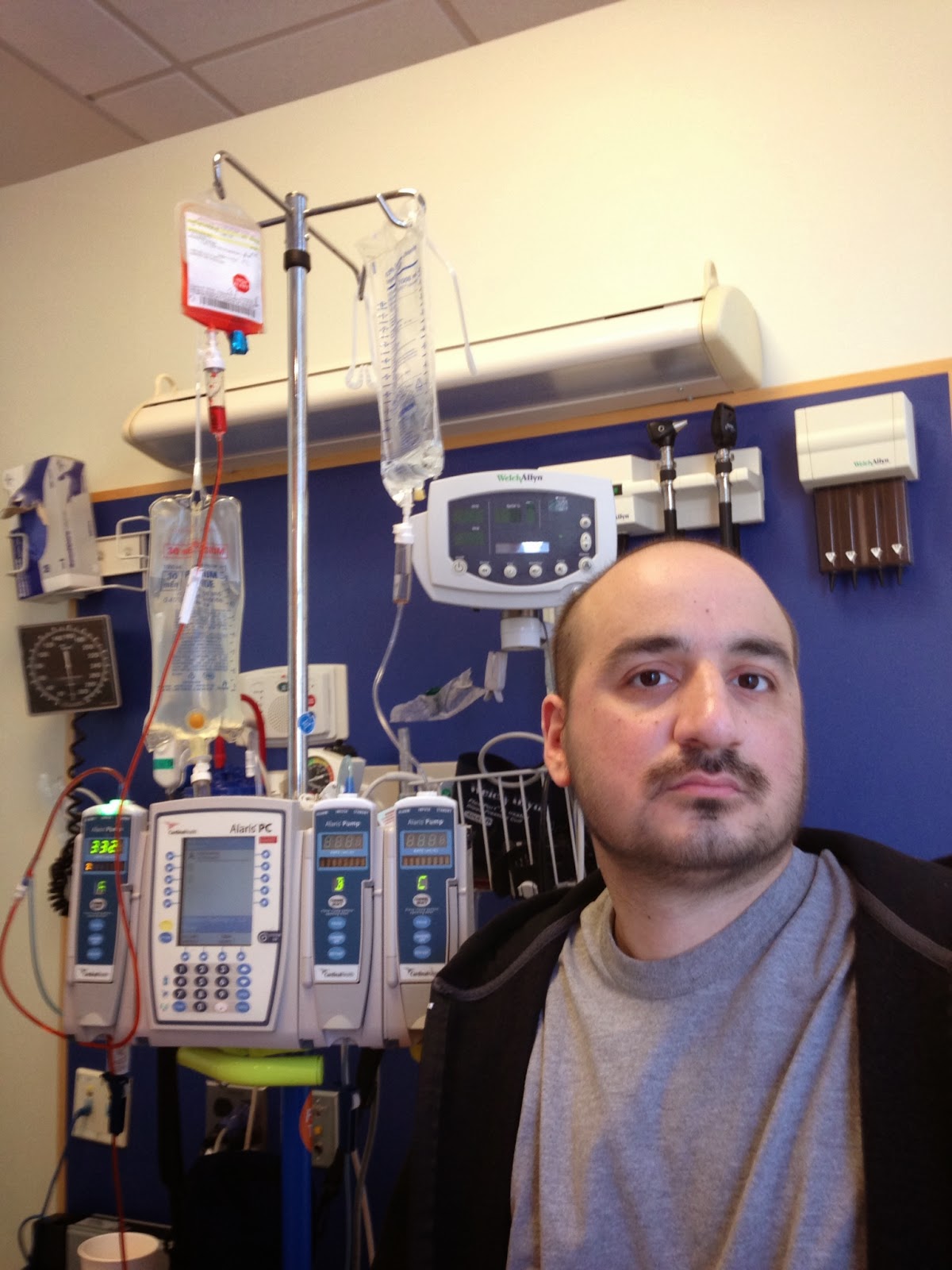 |
| My Monday doxorubicin dose. Harsh stuff. It's bright red color makes me think of the red button in all those childhood cartoons, where bad things happen after it gets pressed. |
Tuesday, November 19, 2013
Delay #2
I was all set to start cycle 15 yesterday. But I awoke that morning with a fever and a sore throat. Chemo was put on hold, with the chance of starting Tuesday as I only needed to come to the clinic for four days for this cycle. When I wasn't getting better, and the results of a nose swab test came back confirming I'd caught a cold, chemo was postponed to next week.
Good news is that I'm feeling better than I was yesterday. The sore throat is gone, and while my nose is now running a bit, I don't feel as feverish or weak as I did yesterday, when I spent most of the day in bed resting. Though I'm not happy about being delayed, I do now have an opportunity to do more Ph.D. work and enjoy more food before I take the beating that cycle 15 will inevitably give me, so I'd best make the most of it.
Good news is that I'm feeling better than I was yesterday. The sore throat is gone, and while my nose is now running a bit, I don't feel as feverish or weak as I did yesterday, when I spent most of the day in bed resting. Though I'm not happy about being delayed, I do now have an opportunity to do more Ph.D. work and enjoy more food before I take the beating that cycle 15 will inevitably give me, so I'd best make the most of it.
Friday, November 15, 2013
Squat Update
No, squats aren't the only rehab exercise I do, but they're my favorite, so I'll be focusing on them here. I had started out doing body weight squats, first using a grab bar to support me, then over a chair in case I slip and fall. I still like to do them over a chair for safety, but now I've added some weight. Not a lot -- I may never be cleared to lift large amounts of weight again because of potential heart damage from doxorubicin, one of the chemo drugs I've received. This is definitely a drag; the weight room was one of my favorite places to work out before my diagnosis. But adding some weight still gives me some of that weight room feeling. In the case of squats, my physical therapist introduced a 2 kg medicine ball, which I hold in front of me with my arms fully extended, before my most recent cycle. Since I don't have my own personal supply of medicine balls, I've substituted my backpack, which I can fill to 2 kg or a bit more if I so desire.
I've made more strides recently. Yesterday and today, I went about my business without using my cane at all. Yesterday, this included walking to a follow-up with my prosthetist, plus then heading to Midtown on the subway to pick up a shirt I'd ordered online and then back to a Trader Joe's on the Upper West Side for groceries before calling it a day. I still take my cane with me even when I don't want to use it in case I get tired, but I'm going to go caneless now as much as I can. I'll still use my cane if my backpack is loaded up, though; going regularly without it while wearing my backpack can be my next step.
I shouldn't say it's just been squats. There are other exercises that have been important -- leg lifts, swaying, stretches, and balancing on my prosthetic leg are some of the other big ones -- but given my huge affinity for the squat that goes back to summer 2012, I'm going to talk it up as much as I can. Plus it provides a nice backdrop for this great video I recently saw and want to share. It's of a ticket machine in the Moscow subway that issues a subway ticket in exchange for 30 squats instead of the usual monetary payment. I wouldn't mind seeing a few of these pop up in New York! :)
I've made more strides recently. Yesterday and today, I went about my business without using my cane at all. Yesterday, this included walking to a follow-up with my prosthetist, plus then heading to Midtown on the subway to pick up a shirt I'd ordered online and then back to a Trader Joe's on the Upper West Side for groceries before calling it a day. I still take my cane with me even when I don't want to use it in case I get tired, but I'm going to go caneless now as much as I can. I'll still use my cane if my backpack is loaded up, though; going regularly without it while wearing my backpack can be my next step.
I shouldn't say it's just been squats. There are other exercises that have been important -- leg lifts, swaying, stretches, and balancing on my prosthetic leg are some of the other big ones -- but given my huge affinity for the squat that goes back to summer 2012, I'm going to talk it up as much as I can. Plus it provides a nice backdrop for this great video I recently saw and want to share. It's of a ticket machine in the Moscow subway that issues a subway ticket in exchange for 30 squats instead of the usual monetary payment. I wouldn't mind seeing a few of these pop up in New York! :)
Thursday, November 14, 2013
Making the Most of the Moment
I currently write in the midst of a good period, but sandwiched in between a bumpy end to cycle 14 and the start of cycle 15. I have a lot of energy right now. When I had my blood counts checked on Monday, my hemoglobin and red blood cell counts were higher than they've been in a long time. The former was in fact in the normal range (a rare occurrence), and the latter was just below normal.
I wish I could say that cycle 14 ended smoothly, but the day after I'd made my last post, my intestines acted up again. Was it the C diff, the irinotecan, or both? I'll never know for sure, but I have a feeling that the irinotecan played a big role, as this was my first time having to forgo the anti-diarrhea measures I usually take, with a noticeable difference in results compared to the cycle 13, which also featured a C diff return. It started with frequent trips to the bathroom on Friday morning. When I went in to get the cycle's last day of chemo, and brought this up, my chemo dose was canceled so as not to risk making things worse. And briefly, things got better. But then the next day, I got worse again, to the point where I was advised to go into urgent care that night. A check of my electrolyte levels thankfully revealed that I had not gotten to the point of being very dehydrated; I received a liter of fluid by IV to keep things that way and then was released. Sunday was another tough day, but by the evening things started to let up a bit. Gradual improvement continued the next two days. By Wednesday, it was all systems go, with me no longer worrying that bad things would happen during the afternoon's physical therapy session. So I expect no delays when it comes to starting cycle 15.
Speaking of that cycle, I know it's going to be a hard one. I've talked at length about the multitude of side effects the cyclophosphamide/doxorubicin/vincristine combo has given me back in the days of cycle 3, most notably nausea, mouth sores, and destroyed taste buds, and I'm expecting them to all come back. Given that, I've told myself that I need to make the most of these next few days before I start, while I still have energy... And my taste buds! Thinking back to how my taste for food got thrown for a loop by my first three cycles, I've made my number one task enjoying some of my favorite foods before my taste for them gets thrown off. One such item is cinnamon rolls; my first three cycles made cinnamon, whose flavor I normally very much like, taste unpalatably bitter. Thankfully, that taste change was not permanent, but it was no fun while it lasted. Another is cotlet. Cotlets are breaded and fried meat and potato patties that in Persian cuisine are commonly put in pita or some other flatbread and enjoyed as a sandwich. I was not very much into them until I invented a version in summer 2012 whose taste I really enjoy. Though protein-heavy foods are something that chemo does not make me lose my taste for, the thing with cotlet is that the presence of bread and potatoes complicates things. My first three cycles wiped out my taste for bread almost entirely, and potatoes I usually wanted only in mashed form. With that in mind, I made a batch of cotlets last night:

Along with a bowl of mast-o-khiar (another Persian dish, this one yogurt with cucumbers, raisins, walnuts, and a mix of herbs), this was my dinner, and it was very tasty. Over the next few days, I'll be eating, working on my thesis, and getting around New York some. I look forward to having cycle 15 behind me, after which the sailing will be a lot smoother.
I wish I could say that cycle 14 ended smoothly, but the day after I'd made my last post, my intestines acted up again. Was it the C diff, the irinotecan, or both? I'll never know for sure, but I have a feeling that the irinotecan played a big role, as this was my first time having to forgo the anti-diarrhea measures I usually take, with a noticeable difference in results compared to the cycle 13, which also featured a C diff return. It started with frequent trips to the bathroom on Friday morning. When I went in to get the cycle's last day of chemo, and brought this up, my chemo dose was canceled so as not to risk making things worse. And briefly, things got better. But then the next day, I got worse again, to the point where I was advised to go into urgent care that night. A check of my electrolyte levels thankfully revealed that I had not gotten to the point of being very dehydrated; I received a liter of fluid by IV to keep things that way and then was released. Sunday was another tough day, but by the evening things started to let up a bit. Gradual improvement continued the next two days. By Wednesday, it was all systems go, with me no longer worrying that bad things would happen during the afternoon's physical therapy session. So I expect no delays when it comes to starting cycle 15.
Speaking of that cycle, I know it's going to be a hard one. I've talked at length about the multitude of side effects the cyclophosphamide/doxorubicin/vincristine combo has given me back in the days of cycle 3, most notably nausea, mouth sores, and destroyed taste buds, and I'm expecting them to all come back. Given that, I've told myself that I need to make the most of these next few days before I start, while I still have energy... And my taste buds! Thinking back to how my taste for food got thrown for a loop by my first three cycles, I've made my number one task enjoying some of my favorite foods before my taste for them gets thrown off. One such item is cinnamon rolls; my first three cycles made cinnamon, whose flavor I normally very much like, taste unpalatably bitter. Thankfully, that taste change was not permanent, but it was no fun while it lasted. Another is cotlet. Cotlets are breaded and fried meat and potato patties that in Persian cuisine are commonly put in pita or some other flatbread and enjoyed as a sandwich. I was not very much into them until I invented a version in summer 2012 whose taste I really enjoy. Though protein-heavy foods are something that chemo does not make me lose my taste for, the thing with cotlet is that the presence of bread and potatoes complicates things. My first three cycles wiped out my taste for bread almost entirely, and potatoes I usually wanted only in mashed form. With that in mind, I made a batch of cotlets last night:
Along with a bowl of mast-o-khiar (another Persian dish, this one yogurt with cucumbers, raisins, walnuts, and a mix of herbs), this was my dinner, and it was very tasty. Over the next few days, I'll be eating, working on my thesis, and getting around New York some. I look forward to having cycle 15 behind me, after which the sailing will be a lot smoother.
Subscribe to:
Posts (Atom)